
Apple 2026 Launch: What It Means for Global Teams
The Apple 2026 Launch announcements and what they mean for IT and People global teams.



Ask ten IT leaders to define Global ITAM and you'll get ten answers. That gap is exactly where companies lose money.
Global ITAM isn't IT asset management with a passport stamp. It's procurement, onboarding, support, storage, offboarding, and buyback running as one system across borders, not ten local fixes stitched together. Get it wrong and it doesn't just cost money. It stalls new hires, buries compliance teams, and turns retired hardware into a liability nobody owns. Get it right and IT stops being the department that slows global hiring down.
Managing hardware in one office, one country, one legal system is hard enough. Multiply that by customs regulations, data-protection law, currencies, time zones, and shipping realities that shift at every border, and "just scale it up" stops working.
That's the real definition: Global ITAM manages the full lifecycle of laptops and hardware for a distributed workforce without every country becoming its own operational silo. Treat it as one process copy-pasted across borders and you hit three walls fast: compliance you didn't know existed, delivery delays that stall onboarding, and end-of-life hardware nobody has a plan for.
The global ITAM software market is valued at USD 2.22 billion in 2026 and is projected to reach USD 3.01 billion by 2031, growing at a 6.28% CAGR, according to Mordor Intelligence. North America holds the largest share at roughly 39.6%, but Asia-Pacific is the fastest-growing region, expanding at 7.43% CAGR through 2031 as India, China, and Japan tighten digital-governance and data-protection mandates.
That growth isn't abstract. It's driven by rules that differ sharply by country:
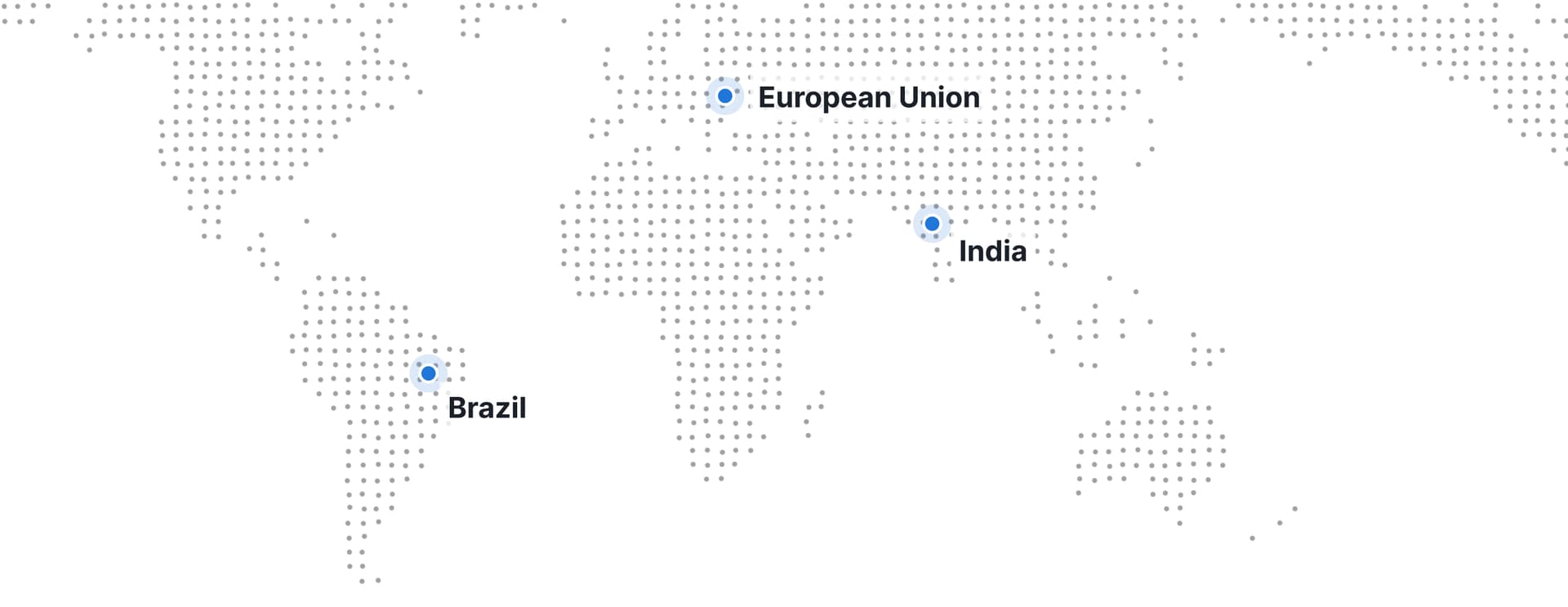
European Union: the WEEE Directive requires certified take-back and recycling for retired hardware, with documented chain of custody.
Brazil: the National Solid Waste Policy (PNRS) mandates reverse logistics for electronics, making manufacturers and distributors responsible for end-of-life collection.
India: the E-Waste (Management) Rules impose Extended Producer Responsibility targets on anyone disposing of IT hardware at scale.
Three regions, three completely different compliance regimes, one laptop lifecycle. That's what "global" actually adds to ITAM: not just more countries, but more rulebooks running at once.

Three failure points show up again and again.
Procurement that ignores local reality. Ordering the same laptop for new hires in São Paulo, Lisbon, and Manila sounds simple until import duties, vendor availability, and local warranty terms turn one order into three separate headaches.
Onboarding that isn't actually fast. A remote hire can't be productive on day one if their equipment is stuck at customs on day twelve. Slow delivery isn't a shipping problem, it's a strategy failure. See how to manage remote employees in different countries for what actually moves the needle.
Offboarding with no exit plan. When someone leaves, that hardware has to be collected, wiped, and redeployed or recycled. Multiply that across dozens of countries and "we'll figure it out" stops being a strategy and becomes a liability.
Done right, Global ITAM covers the entire hardware lifecycle as one connected process, not a country-by-country improvisation:
Procurement sourced locally where it makes sense, so equipment doesn't sit stuck in transit or customs.
Onboarding fast enough that new hires are working in days, not weeks.
Support that doesn't require an employee to file a ticket in a time zone eight hours away.
Storage for spare or returning equipment, so there's always a buffer instead of another procurement cycle.
Offboarding and buyback, so retired hardware gets collected, secured, and resold or recycled instead of sitting in a drawer. Read the complete guide to IT asset disposition for what a compliant exit process actually requires.
Tecspal runs this model across 160+ countries for 800+ companies, with a 3.5-day average delivery time and IT cost savings of up to 45%. That's not a coincidence, it's what happens when procurement, onboarding, support, storage, and offboarding stop operating as separate departments and start operating as one system.

Companies that run Global ITAM piecemeal, different vendors per region, different processes per office, pay for it twice. Once in the premium for fragmented, small-scale purchasing. Again in the operational hours lost coordinating it all.
Centralize that complexity instead, and the savings show up immediately: up to 45% lower IT costs, without adding headcount to manage the sprawl. That's the difference between ITAM as a cost center and ITAM as leverage.
The companies that get Global ITAM right aren't running the fanciest asset-tracking software. They're running procurement, onboarding, support, storage, and offboarding as one connected system, regardless of which country an employee logs in from. That's the model backing Tecspal's 4.7 Trustpilot rating across 160+ countries.
If IT asset management still feels like a different process in every office, more spreadsheets won't fix it. A global ITAM partner will.
Explore our
topics
The Apple 2026 Launch announcements and what they mean for IT and People global teams.

Looking for the best corporate laptops? Compare top picks for remote teams by battery life, power and price, then see how Tecspal equips anywhere.
1 min read

Australian companies hiring in India: cost, talent and and why IT asset management can't be an afterthought.
1 min read



contact@tecspal.com
+1 305-450-4911
111 Pine St #1650, San Francisco, CA
Subscribe to our weekly newsletter to receive the latest news and updates.