
Apple 2026 Launch: What It Means for Global Teams
The Apple 2026 Launch announcements and what they mean for IT and People global teams.

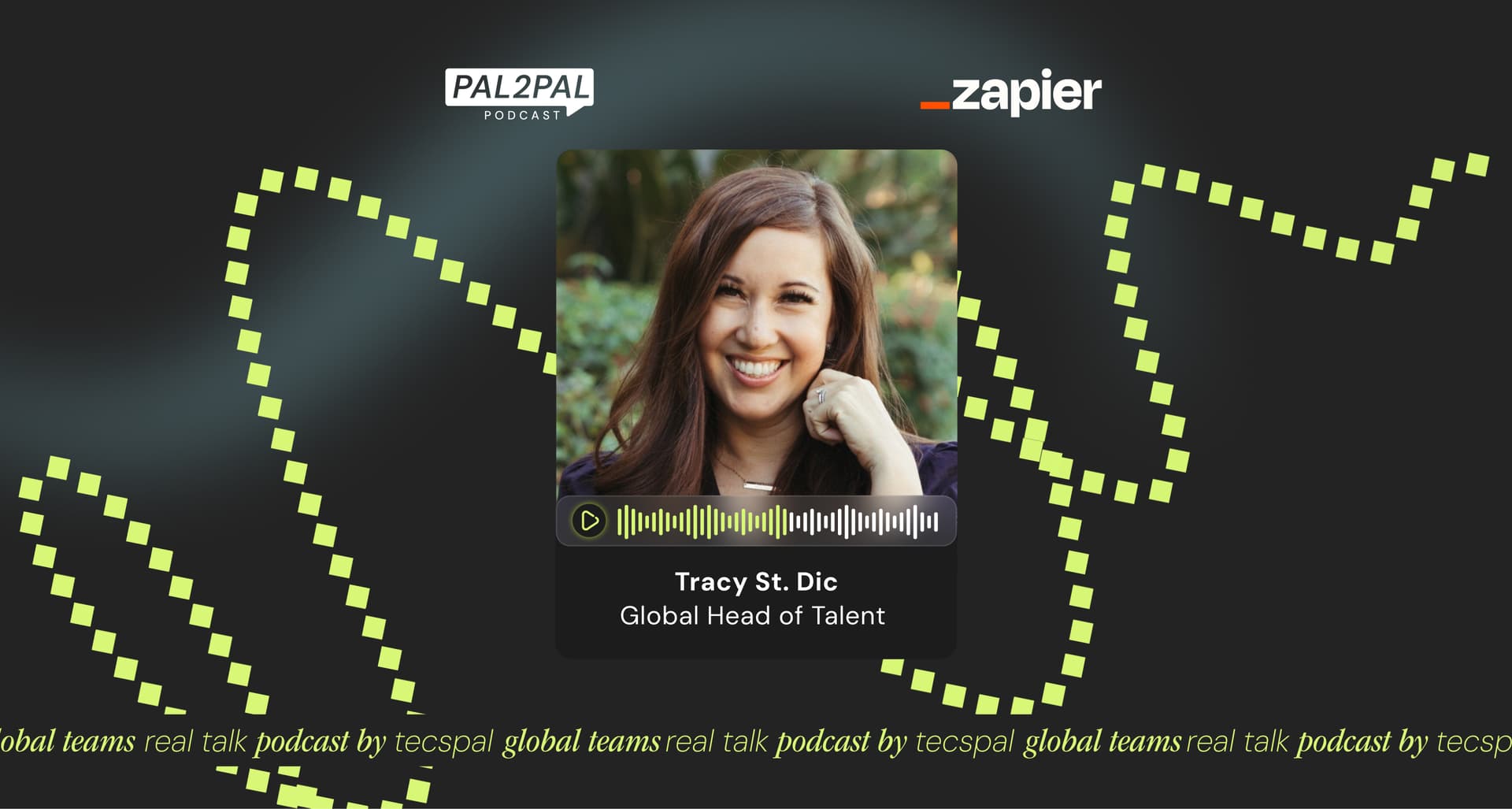
Hosted by Juan Manuel Cat, Pal2Pal brings together industry leaders who are redefining how companies grow and scale beyond borders.
In Episode 5, Juan sits down with Tracy St. Dic, Head of Talent at Zapier, to explore what it really takes to build and manage global, remote-first teams in an era where AI is reshaping everything from job postings to onboarding.
With Zapier operating across 42 countries and close to 900 employees, Tracy brings hard-won experience on global hiring at scale, the evolving role of AI in talent, and why the human element remains irreplaceable at every stage of the employee journey.
Key Insights by Timestamp
[00:01] Welcome to Episode 5
[00:43] Chapter 1: Global Hiring at Scale – What breaks first when you scale too fast
[02:01] What leaders underestimate about hiring outside their home country
[03:57] How Zapier maintains hiring quality across continents
[04:55] Chapter 2: Leadership Strategy & the Future of Work – New roles emerging in talent teams
[06:56] Managing candidate expectations as AI accelerates
[08:39] Remote-native vs. hybrid: the structural advantage
[11:27] Chapter 3: Human vs. AI in Modern Recruitment – Adoption vs. transformation
[13:20] The mental leap from AI adoption to AI transformation
[15:08] Which parts of recruitment will always stay human
[17:12] How AI can improve fairness and reduce bias
[18:56] Chapter 4: The Employee First Experience – Onboarding, tools & access
[21:02] Why the human touch in onboarding can’t be automated away
Episode Summary: Hiring, AI & Global Teams
1. What Breaks First When Scaling Global Hiring
When companies rush global expansion, the first thing that fractures is context. Tracy is direct: “Speed often outpaces clarity. Teams start hiring before the right systems, policies, or talent philosophies are in place.”
The downstream effects are real: inconsistent candidate experiences, misaligned expectations during onboarding, and performance gaps that can be traced back to a lack of upfront structure. At Zapier, the answer was intentional investment in the “not sexy” work – documentation, calibration, and interviewer training – before scaling headcount.
2. Cultural Assumptions Are the Biggest Blind Spot
Leaders often don’t realize how much they culturally assume in a hiring process. Communication styles, interview behaviors, and even how feedback is delivered are deeply shaped by the country where the interviewer grew up and built their career.
Tracy points to Zapier’s 2025 expansion into India as a case study in getting this right. Before launching bulk hiring there, the team researched local practices intensively – speaking with people who had hired in India, live there now, and know the market. This shaped everything: notice periods, offer structures, sign-on bonuses, and even how the interview process was condensed to be respectful of time zones.
3. Consistency Without Uniformity
Maintaining quality across continents doesn’t mean running an identical process everywhere. Tracy’s approach: shared expectations, not uniform execution.
Zapier uses structured interviews, clear rubrics, and a well-defined talent bar – but leaves room for local nuance. The team records and regularly audits interviews to ensure they’re assessing for skills and mindset, not just how someone presents themselves in an interview setting.
4. New Roles Emerging Inside Talent Teams
Talent functions are evolving faster than most org charts can capture. Tracy identifies two major shifts:
Workflow architects: Practitioners who can design end-to-end talent and onboarding journeys using AI and automation. Not IT specialists – people with deep subject matter expertise who also know how to build.
Candidate concierges: As scheduling and coordination get automated, human bandwidth shifts toward richer candidate interaction, ensuring top candidates feel genuinely seen and supported throughout the process.
5. Candidate Expectations Are Evolving Fast
Candidates already want to know: are you using AI? Will a human actually see my application? Tracy believes this demand for transparency will only intensify – and it will be paired with a growing expectation for personalization and speed.
Since Zapier assumes candidates are using AI throughout their process, the company has published clear guidelines on how AI use is acceptable, and where the line is. In three years, Tracy predicts candidates will expect genuine, human-authored feedback on why they weren’t selected. Because with AI assisting recruiters, there’s no longer an excuse not to give it.
6. The Remote-Native Structural Advantage
Remote-first companies like Zapier (remote since 2011–2012) didn’t just adopt remote work – they built every system around it. No legacy office costs. Hiring, onboarding, and culture rituals all designed to scale across time zones from day one.
But the deeper advantage, Tracy argues, is context richness. When decisions happen in Slack, memos, and recorded video calls, everything is documented and searchable. Hybrid or office-first companies risk losing critical institutional knowledge in whiteboard sessions and hallway conversations that no one recorded.
For AI adoption, this matters enormously. Distributed, digital-first systems allow companies to retrieve, surface, and build on their own institutional knowledge in ways office-dependent cultures simply cannot.
7. From AI Adoption to AI Transformation
Most companies are in adoptive mode: using AI to speed up existing processes. Save 10%, save 50%. That’s personal productivity, and it’s valuable – but it’s not transformation.
Transformative AI asks harder questions: Should this process exist at all? It means breaking down workflows, questioning who does what and why, and rebuilding for outcomes rather than just faster steps.
Tracy’s head of L&D calls it “re-designing the factory.” The goal isn’t to make the assembly line go faster – it’s to question whether that assembly line is the right design at all.
8. Human Decision-Making Is Non-Negotiable
No matter how good the AI tooling gets, employment decisions remain a human responsibility. Tracy is clear: “You can delegate the work, but not the accountability.” (A principle she credits to Zapier’s CTO, Brian Helmick.)
At Zapier, AI is used to surface insights, identify trends, summarize data, and prepare interviewers – but every hiring decision is made by a human. The same principle applies to candidates: using AI to research or sharpen interview prep is encouraged, but simulating expertise you don’t have crosses a clear line.
9. AI as a Tool for Fairer Hiring
Bad data in, bad data out. If a company designs its AI-assisted hiring around biased inputs – say, a preference for Ivy League universities – the AI will simply amplify that bias at scale.
But the inverse is equally powerful: when systems are designed thoughtfully, AI can reduce the inconsistencies that are natural for humans. A recruiter on their 15th screen of the day is tired. AI-assisted notes, recordings, and structured rubrics ensure that the quality of evaluation doesn’t erode as the day goes on.
10. The First Days Set the Tone
Onboarding isn’t just logistics – it’s a signal. A smooth, automated, on-time setup tells a new hire: this is a company that respects your time and is set up to help you succeed. A broken access link or a missing laptop says the opposite.
At Zapier, an automated onboarding flow handles 30+ steps – account setup, document sharing, swag and hardware, first meeting scheduling – all seamlessly. But the key insight is what automation enables: the onboarding team’s human bandwidth is freed to be genuinely present with new hires in the moments that actually matter.
Final Thoughts
The conversation with Tracy makes one thing clear: the companies that will win the talent race aren’t the ones using the most AI, but the ones using it most intentionally. With the right structures, global hiring doesn’t have to mean compromised quality or cultural blind spots. With the right mindset, AI transformation doesn’t mean replacing people – it means freeing them to do the work that only humans can do.
For companies building global teams today, the lesson from Zapier is simple: invest in the unsexy work first. Document everything. Calibrate constantly. And never automate away the moments that define how people feel about your company.
Pal2Pal Podcast by Tecspal: Listen Now!
Get practical insights from Tracy on building global talent strategies, navigating the human-AI balance in hiring, and why the first day at work matters more than ever.
Want to explore IT asset management solutions to improve your global team’s onboarding experience? Join the conversation and contact us!
Explore our
topics
The Apple 2026 Launch announcements and what they mean for IT and People global teams.

Looking for the best corporate laptops? Compare top picks for remote teams by battery life, power and price, then see how Tecspal equips anywhere.
1 min read

Australian companies hiring in India: cost, talent and and why IT asset management can't be an afterthought.
1 min read



contact@tecspal.com
+1 305-450-4911
111 Pine St #1650, San Francisco, CA
Subscribe to our weekly newsletter to receive the latest news and updates.